There is a word in German that has no direct English translation: Qualitätsarbeit. It means quality workmanship — but it carries something deeper than a technical standard. It implies a worldview: that excellence is not optional, that doing something properly the first time is a moral commitment as much as a professional one, and that the documentation to prove it is as important as the work itself.
This philosophy built Mercedes-Benz, Siemens, and SAP. It gave the world precision manufacturing, rigorous process engineering, and the concept of the Mittelstand — a class of mid-sized companies so technically excellent that they dominate global niches for decades. It is one of the most powerful forces in the history of industrial and technological development.
And yet when German companies — or any company that shares this engineering ethos — look offshore for software development partners, they almost always encounter the same disappointment: a partner that builds fast but documents nothing, delivers code that works today but crumbles under maintenance tomorrow, and communicates in English but thinks in a fundamentally different register about quality.
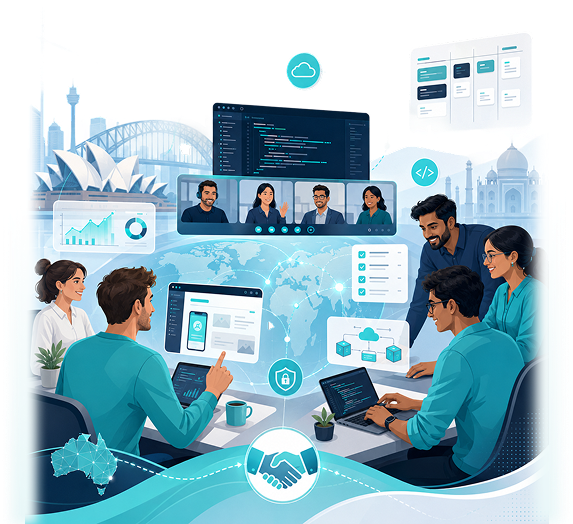
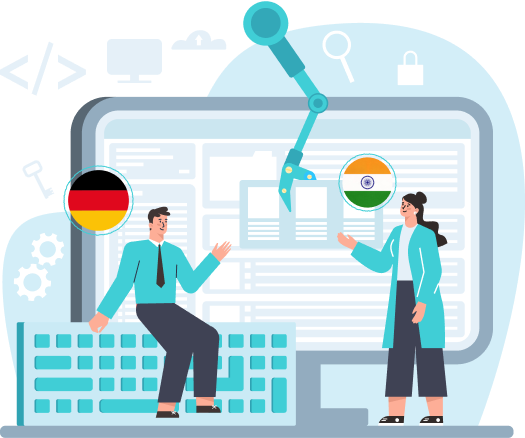
This article is about what happens when you stop treating that gap as inevitable — and start engineering the offshore relationship itself with the same rigour you'd apply to any other engineering problem. The result is what we call the German-Indian synthesis model: offshore development that thinks like Bosch and moves like a startup.
"The problem isn't Indian software quality. The problem is that most offshore firms aren't built to serve the engineering culture that demands Qualitätsarbeit. That's a process problem — and process problems are solvable."
The German Engineering Ethos — What It Actually Demands
To understand the synthesis, you first need to understand what German engineering culture actually demands from a technology partner. It is not merely high standards. It is a specific operating philosophy with identifiable characteristics that most offshore development models were never designed to accommodate.
German Engineering Culture
The Demand Side
Comprehensive documentation at every stage
Predictable, accountable delivery rhythms
Security and compliance built into architecture
Code that is maintainable decades from now
Technical decisions justified with reasoning
No shortcuts — even when deadlines press
Post-handover ownership and responsibility
Indian Software Strengths
The Supply Side
World's deepest engineering talent pipeline
Agile sprint execution at scale
Cost structure 50–70% below European rates
English-language technical fluency
Deep experience with global enterprise systems
Timezone that allows daily EU overlap
Decades of UK/US enterprise delivery track record
The synthesis produces something neither side achieves alone
The problem most offshore engagements encounter is not a talent gap — India has no shortage of exceptional engineers. It is a process alignment gap. German companies ship broken requirements to partners who build exactly what was specified, not what was actually needed. Code arrives without architecture documentation. Changes are accepted verbally and later disputed. The product launches and nobody knows how to maintain it.
None of this is inherent to Indian software development. It is the result of matching a Qualitätsarbeit mindset with a partner whose process model was designed for speed-first, cost-first clients. The solution is not to lower the standard — it is to find, or build, a partnership whose internal processes embody that standard.
What India Does That Europe Cannot Scale
Before addressing the synthesis, it is worth being specific about why India — and not nearshore European alternatives — is the right partner for engineering-led companies in 2026.
Eastern European nearshoring — Poland, Czech Republic, Romania — offers timezone proximity, but the talent pool is increasingly constrained and attrition rates are rising as US companies absorb local talent through remote hiring. For an engineering-intensive build requiring a team of six to twelve, assembling that team in Warsaw in 2026 takes months and costs nearly as much as hiring domestically in Germany.
India solves the scale problem that Europe cannot. An established Indian development firm can assemble a fully experienced team in two to four weeks. The talent depth exists across every major technology stack. And the cost savings are sufficient to fund two complete additional product development cycles with the budget of one domestic hire.
The question is never whether India can supply the talent. The question is whether the partner has the process architecture to direct that talent toward the quality standard that engineering-led clients demand.
The Five Pillars of the German-Indian Synthesis Model
The synthesis model is not a philosophy — it is a set of concrete, enforceable processes. Each of the five pillars below represents a specific area where the German engineering ethos can be operationalised within an Indian offshore engagement, transforming a generic vendor relationship into a genuine technical partnership.
01. Documentation as a First-Class Engineering Deliverable
In German engineering culture, documentation is not an afterthought — it is a primary output. A Volkswagen engine does not leave the factory without a complete record of every test, tolerance, and specification. Software built for engineering-led companies should operate by the same principle.
In practice, this means: a Technical Architecture Document produced before the first line of code. API documentation maintained in real-time throughout the build. Inline code documentation written to the standard of a senior engineer who will maintain this codebase in three years without the original team. A deployment guide that a competent developer could follow without assistance.
Ask any potential partner this question: "If your entire development team left tomorrow, how long would it take a new engineer to understand this codebase?" The answer is diagnostic. Partners aligned with a Qualitätsarbeit standard target days. Others shrug and mention it would take a while.
Projects with living, maintained technical documentation experience 68% fewer critical bugs during maintenance phases compared to underdocumented codebases. (IEEE Software Engineering Journal, 2025)
02. Process Rigour That Rivals Manufacturing Quality Gates
German manufacturing pioneered the quality gate — a formal checkpoint where a product cannot advance until it meets defined standards. Software development has an equivalent: the structured sprint cycle with acceptance criteria, code review gates, and QA sign-off before any code reaches staging.
The synthesis model applies manufacturing-quality gate thinking to software delivery. Every sprint has clear acceptance criteria defined at planning stage. No pull request merges without a peer code review against agreed standards. QA produces a documented test report before sprint completion. Defects are tracked, categorised, and resolved before new feature work begins.
This process rigour is not bureaucratic overhead — it is the mechanism that makes velocity sustainable. Teams that skip quality gates move faster for two sprints and slower for twenty.
03. Security Architecture That Reflects European Regulatory Reality
European companies operate in one of the world's most demanding regulatory environments for data and software security. GDPR, the NIS2 Directive, Germany's BDSG, and industry-specific frameworks like DSGVO create obligations that cannot be retrofitted after launch without significant cost and risk.
The synthesis model treats security architecture as a design-stage requirement, not a post-launch compliance exercise. This means: OWASP Top 10 testing built into the QA cycle as standard. Data residency decisions made at architecture stage, not sprint four. Penetration testing protocols defined before the first user touches staging. And a Data Processing Agreement in place before a single line of production code is written.
Partners who have genuine experience building for European clients understand these requirements intuitively. Those who have built primarily for US clients will have gaps — ask specifically about GDPR implementation in their recent projects, not about compliance as a concept.
04. Communication Architecture Built for Technical Depth
German engineering teams communicate differently from American product teams. They expect technical depth, not feature-level updates. They want to understand architectural tradeoffs, not just sprint velocity. They ask hard questions about why a particular approach was chosen — and they expect written answers, not verbal reassurances.
The synthesis model designs the communication architecture to serve this expectation. This means: a dedicated technical lead on the offshore team who can engage directly with senior engineers on the client side. Weekly written technical summaries covering decisions made, options considered, and risks identified. Architecture decision records — a lightweight but powerful practice of documenting significant technical decisions and their rationale — maintained throughout the build.
For German-speaking clients and European Mittelstand companies, we also support partial German-language technical documentation — an uncommon but significantly valued capability for companies whose core technical team operates in German.
05. Long-Term Ownership Mindset — Built for Decades, Not Sprints
German engineering is famously long-termist. Bosch invests in platform infrastructure that won't generate returns for a decade. Mittelstand companies build supplier relationships that span generations. This temporal orientation is deeply at odds with the typical offshore vendor mindset — optimising for the current contract, not the ten-year maintenance horizon.
The synthesis model explicitly plans for the end state from the beginning. Architecture decisions are evaluated against a five-year scalability horizon. Technical debt is quantified and actively managed rather than silently accumulated. Handover protocols are designed to make the client's future team fully self-sufficient. And the codebase is written as if the next developer is a senior engineer who has never met the original team.
This long-termism is not idealism — it is the only engineering stance consistent with building systems that serve a business over a meaningful lifecycle.
Where the Synthesis Model Wins — Real-World Applications
The German-Indian synthesis model is not a niche approach for a specific sector. It is particularly powerful wherever the client organisation has a high internal engineering standard and needs an offshore partner that will match, not dilute, that standard. In practice, this includes:
| Industry / Use Case | What Traditional Offshore Fails On | How the Synthesis Model Delivers |
|---|---|---|
| Industrial IoT & Embedded Systems | Underdocumented APIs, no hardware integration protocols, security afterthought | Architecture docs from day one; hardware protocol agreements defined at discovery; security built into OT/IT boundary design |
| ERP / SAP Integration | Partners unfamiliar with German ERP conventions or DATEV/GoBD compliance requirements | Compliance-aware architecture; DATEV-compatible data flows; structured integration documentation for audit purposes |
| Mittelstand B2B Platforms | MVPs built for US market assumptions; German UX/UE conventions ignored | Discovery phase includes explicit German-market user research; B2B German UX patterns applied; DACH-specific compliance built in |
| Manufacturing Execution Systems (MES) | Offshore partners unfamiliar with production floor realities or ISO/DIN standards | Technical discovery includes process mapping against ISO standards; architecture reviewed against IEC 62264 manufacturing integration frameworks |
| Automotive Tier-2 Software | AUTOSAR/MISRA-C awareness absent; no functional safety orientation | Automotive-aware technical team; ASPICE-aligned development process documentation; traceable requirements management |
The common thread across every use case: the synthesis model applies the same disciplined thinking to process design that German engineering applies to product design. The partnership is engineered, not assembled.
Why Atologist Infotech Is the Right Technology Partner
Atologist Infotech was built with a specific insight: that the offshore development market has optimised for the wrong clients. Most offshore firms have built their processes to serve US product startups — speed-first, iteration-heavy, with quality as a secondary consideration. German and European engineering-led businesses need something fundamentally different.
We have designed every dimension of our engagement model around the principle that quality is a process outcome, not a talent outcome. We hire exceptional engineers — but we also build the process architecture that directs their talent toward the documentation, rigour, and long-term thinking that engineering-led clients demand.
This is not a positioning claim. It is a set of verifiable practices — every one of which you can examine, challenge, and test during a technical evaluation conversation before you commit to anything.
The Engineering Question Worth Asking
German engineering gave the world a standard that the rest of the world aspires to. It is not slower than alternatives — a properly engineered system is faster to maintain, cheaper to scale, and more reliable in production than one assembled quickly and patched continuously. The economics of Qualitätsarbeit are sound.
The question facing every engineering-led company evaluating offshore development in 2026 is not whether to work with Indian software firms. The data on talent depth, cost efficiency, and delivery capability is decisive. The question is whether you can find a partner whose internal engineering culture is a genuine match for your own.
The German-Indian synthesis model is not a compromise between speed and quality. It is the recognition that the best outcomes come from engineering the partnership with the same rigour you'd apply to any complex system — clear requirements, defined quality gates, documented decisions, and a relentless commitment to the long-term health of what you're building together.
"The best offshore partnership is engineered, not assembled. Apply the same rigour to choosing and structuring your development relationship that you apply to the product itself — and the quality of the outcome follows naturally."